
Ethereum Foundation Researcher Claims: Solana's Golden Age is Over, Will be Surpassed by ETH L2


Original Title: "Ethereum Foundation Researcher: Solana's Golden Age is Over! Two Major Advantages Will Be Overtaken by ETH L2"
Original Author: Ting, BlockTempo of Doo Wan Inc.
During this bull market cycle, the public blockchain Solana, with its fast transaction speed and low gas fees, has dominated the majority of the meme season frenzy traffic, and on November 22, the SOL token price broke through $260, hitting a new all-time high.
In contrast, the leading blockchain Ethereum has not seen significant breakthroughs in recent ecosystem development, coupled with high gas fee issues, causing on-chain users to stay away, thereby keeping the Ethereum price continuously sluggish.
However, Ethereum Foundation researcher Justin Drake recently stated that Solana's good days may be coming to an end.
Ethereum Foundation Researcher: Solana's Golden Age Coming to an End
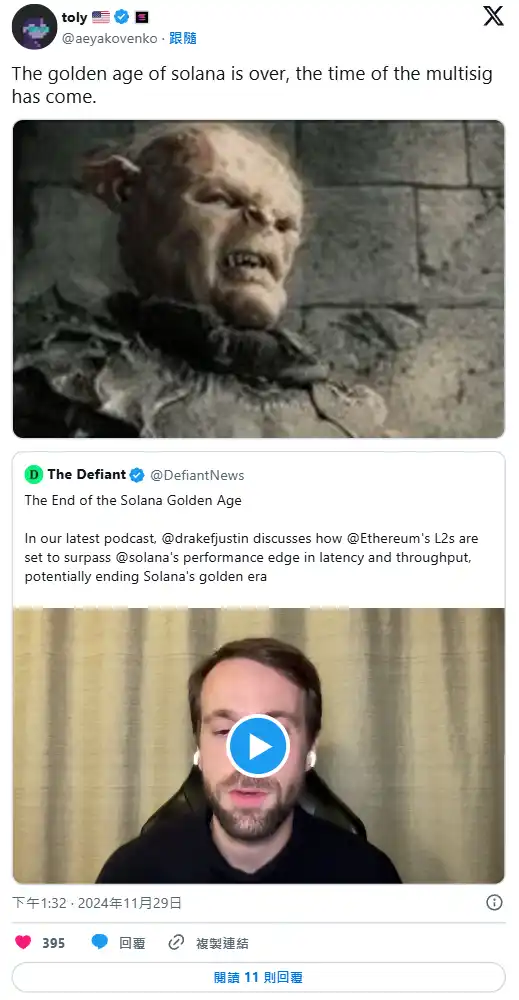
The crypto media outlet The Defiant tweeted today (29th) that in the latest episode of the podcast, Ethereum Foundation researcher Justin Drake discussed how Ethereum Layer 2 is poised to surpass Solana in terms of latency and throughput, bluntly stating that Solana's golden age is about to end:
Bitcoin, Ethereum, and Solana: Different Focuses of Competition
Justin Drake:
To sum up this competition, you could say: on one hand, Bitcoin's competitive advantage lies in its stability, Lindy effect (historical persistence), and monetary properties; whereas Beam Chain's focus is to maximize Ethereum Layer 1's efficiency, making its competition with Bitcoin more direct. On the other hand, Solana's core is its performance.
In my model, Solana's competitor is actually Ethereum's Layer 2, not Layer 1 itself. For Solana, the good news is that it has excelled in two key performance indicators in the past year or two: latency and throughput.
Solana's Advantages Fading: Latency and Throughput
Justin Drake:
In terms of Latency, Solana has a very short slot time. However, for Ethereum, the arrival of a pre-confirmation mechanism will significantly improve latency, even surpassing Solana. Currently, Solana's average latency is 200 milliseconds. But the pre-confirmation mechanism will reduce latency to around 10 milliseconds, meaning a 20x improvement in slot latency.
In terms of Throughput, this year we have witnessed the thriving development of Layer 2. A website, rollup.wtf, shows the growth of throughput from a computational perspective (measured in gas per second). Ethereum aims to have the entire ecosystem process as many transactions as possible, and Layer 2 has demonstrated its ability to horizontally scale. Currently, the overall throughput of Layer 2 is about 100 times higher than Ethereum Layer 1, and it is very likely to grow to 1,000 times or even 10,000 times next year. This is a sustainable and scalable architecture.
Meanwhile, Solana's strategy is to concentrate all activity on a single server. Each validation node requires a large server to handle all activities, but the performance of these servers has basically reached its limit, so a significant increase in throughput is not possible. I believe Solana will not be able to increase its gas limit by 10x next year, while Ethereum is likely to expand the overall gas limit by 10x through Layer 2.
In summary, we may be about to see the end of Solana's golden age, as its two once-proud performance metrics will no longer provide a competitive advantage.
Interestingly, Solana co-founder Anatoly Yakovenko also referenced a tweet from The Defiant and an accompanying image:
"Solana's golden age is over, the era of multi-sigs has come."
This tweet seems to have a sarcastic tone, suggesting that the Ethereum Foundation lacks practical accomplishments and only uses the statement "Ethereum is about to surpass Solana" to motivate users and developers within its ecosystem. (Note: The Ethereum ecosystem places great emphasis on technologies such as multi-signature, account abstraction, etc.)
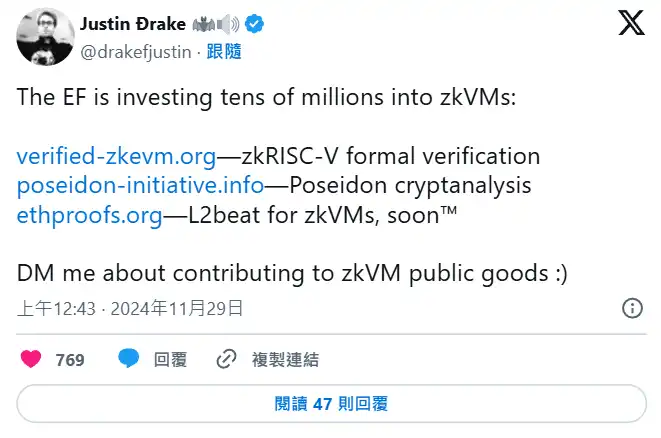
The Ethereum Foundation Invests Millions of Dollars in zkVMs
On the other hand, Ethereum Foundation researcher Justin Drake also tweeted today (29) that the Ethereum Foundation is investing tens of millions of dollars in the zkVMs project, including zkRISC-V formal verification, Poseidon cryptanalysis, and L2beat for zkVMs.
You may also like

The U.S. government prohibits foreigners from using Fable 5, Anthropic issues a rebuttal

The other side of Musk's trillion-dollar fortune: 85% cannot be sold

Citibank releases "2030 Asset Tokenization Market Outlook": 6 major trends may create a $8.2 trillion market

The trillion-dollar valuation test: Are the three major super IPOs a celebration for tech stocks or a nightmare for the crypto market?

Morning Report | Digital Asset completes $355 million financing led by a16z Crypto; Meta completes operational separation from Manus

a16z Crypto Partner: Cash flow is the moat

Cryptocurrency market makers collectively seek change as it becomes increasingly difficult to make money

How TradeXYZ, xStocks, and Alpaca break down the SpaceX IPO into three different strategies

$75 billion in risk asset redistribution: How will SpaceX's IPO affect U.S. stocks and Bitcoin?

Why Is BlackRock Investing $5 Billion in the SpaceX IPO?
Morning News | CME Group launches Nasdaq Cryptocurrency Index futures; Asset management giant Janus Henderson strategically invests in Ethena

Bitcoin Layer 2 Network Botanix: Why Did We Choose to Dissolve?

Why did Oracle deliver the strongest financial report in history, yet its stock price fell?
When the P2P illicit funds from ten years ago turned into 60,000 bitcoins
Dialogue with OmenX Founder: Why does the prediction market need an evolution from "spot" to "derivatives"?
Galaxy in-depth report: Is Solana still worth paying attention to?
Young people in South Korea make a "final effort" in the epic bull market
The pricing controversy of Trade.xyz exposes the fatal weakness of Pre-IPO perpetual contracts
The U.S. government prohibits foreigners from using Fable 5, Anthropic issues a rebuttal
The other side of Musk's trillion-dollar fortune: 85% cannot be sold
Citibank releases "2030 Asset Tokenization Market Outlook": 6 major trends may create a $8.2 trillion market
The trillion-dollar valuation test: Are the three major super IPOs a celebration for tech stocks or a nightmare for the crypto market?
Morning Report | Digital Asset completes $355 million financing led by a16z Crypto; Meta completes operational separation from Manus
a16z Crypto Partner: Cash flow is the moat


